The market for AI writing tools has matured dramatically in 2026. What was once a novelty — AI that could string grammatically correct sentences together — has become an indispensable productivity layer for content marketers, copywriters, novelists, journalists, and business writers. The best tools now produce first drafts that require 20–30% editing rather than complete rewrites, handle nuanced tonal shifts, and maintain brand voice consistency across thousands of pieces of content.
This guide compares the top AI writing tools available in 2026, with honest assessments of where each excels and where it falls short. For a broader overview of the AI landscape, see our best AI tools guide for 2026.
Best AI Writing Tools at a Glance
| Tool | Best For | Starting Price | Strengths |
|---|---|---|---|
| Claude (Anthropic) | Long-form, nuanced writing | Free / $20/mo | Most natural prose, best at tone |
| ChatGPT (OpenAI) | Versatile writing + research | Free / $20/mo | Breadth of tasks, research synthesis |
| Jasper AI | Marketing teams, brand voice | $49/mo | Brand voice training, team workflows |
| Copy.ai | Short-form marketing copy | Free / $49/mo | Fast ad copy, social posts, emails |
| Writesonic | SEO content at scale | $20/mo | Factual accuracy mode, SEO integration |
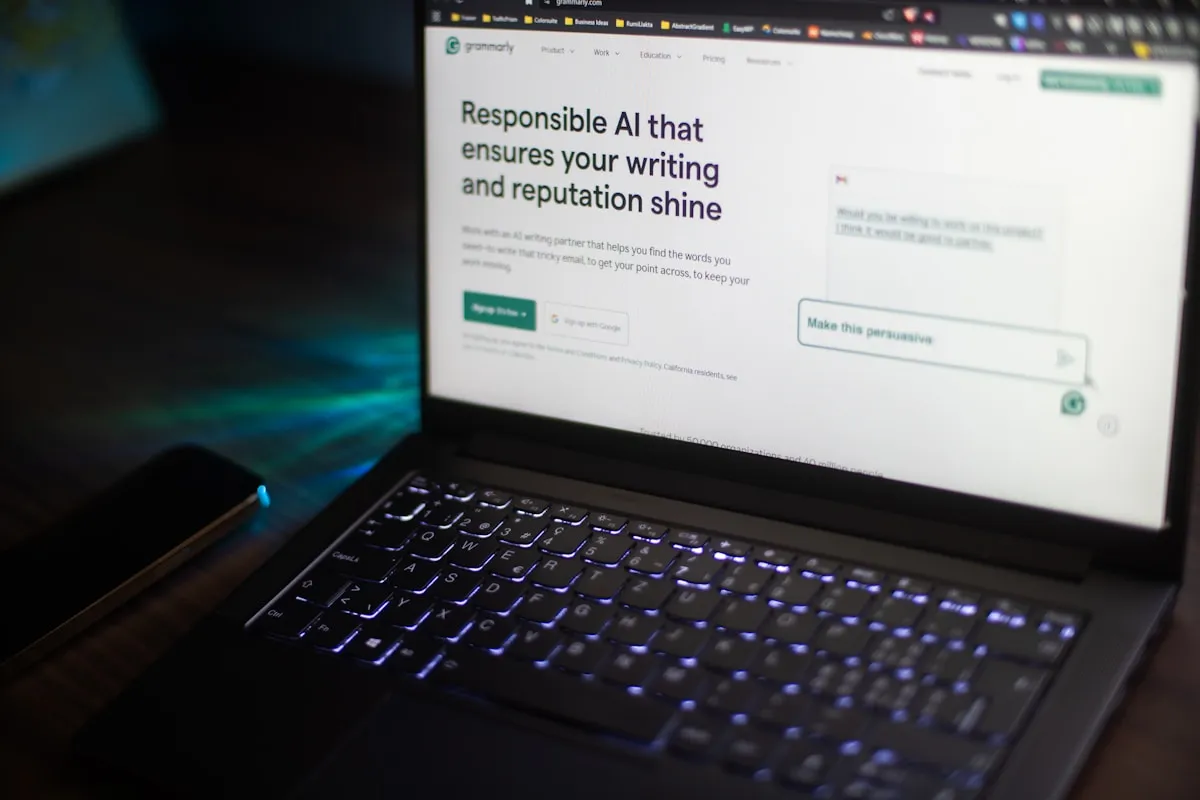
| Grammarly | Writing editing + style guide | Free / $12/mo | Real-time suggestions, brand style guide |
| Notion AI | Writing inside Notion workspace | $10/mo add-on | Seamless integration, document context |
1. Claude (Anthropic) — Best for Long-Form and Nuanced Writing
Claude Sonnet and Claude Opus produce the most natural-sounding prose of any major AI model in 2026. Anthropic’s Constitutional AI training approach results in outputs that feel less formulaic, more contextually aware, and significantly less prone to the repetitive transitions and hollow phrasing that plague most AI writing. For essays, long-form articles, book chapters, reports, and any writing where voice and nuance matter — Claude is the benchmark.
Key strengths:
- Best prose quality for literary and long-form work
- Understands and maintains complex tonal instructions
- 200,000-token context window — can work with an entire manuscript
- Strong at structured analysis and synthesizing complex sources
- Projects feature for multi-document, multi-session writing work
Limitations: Less strong on short punchy marketing copy compared to purpose-built tools. Limited templates compared to Jasper. Training data cutoff limits very recent factual claims.
2. ChatGPT (OpenAI) — Best All-Around Writing Assistant
ChatGPT remains the most versatile writing assistant available. Its strength is breadth: it can shift from writing a product description to drafting a legal letter to generating a children’s story, all within the same session. GPT-4o’s multimodal capabilities allow it to write about images and charts, making it uniquely useful for content that references visual data.
Key strengths:
- Widest range of content types handled competently
- Custom Instructions allow persistent persona and style settings
- Web browsing for current information in Plus tier
- DALL-E image generation integrated for illustrated content
- Free tier remains one of the most capable in the market
Limitations: Prose can sound more formulaic than Claude for literary work. Requires careful prompting to avoid generic output on broad topics.
3. Jasper AI — Best for Marketing Teams
Jasper has evolved from a simple AI writing tool into a full content marketing platform. Its Brand Voice training allows teams to define specific tone, vocabulary, and style guidelines that constrain AI output — ensuring every piece of content sounds like it came from the same brand regardless of which team member generated it. For content marketing agencies and multi-brand companies, this consistency is genuinely valuable.
Key strengths:
- Brand Voice training for multi-writer consistency
- 50+ marketing-specific templates (Facebook ads, email sequences, product descriptions)
- Campaign workflows (brief → outline → draft in one interface)
- Plagiarism checker included
- Team collaboration and approval workflows
Limitations: Meaningfully more expensive than general-purpose AI tools. Overkill for individual creators. Underlying model quality is comparable to ChatGPT — the premium is in the workflow, not the writing itself.
4. Copy.ai — Best for Short-Form Marketing Copy
Copy.ai specializes in high-volume, short-form marketing content: email subject lines, social media captions, ad headlines, product descriptions, and CTA copy. Its interface is optimized for generating multiple variations quickly, which suits split-testing workflows. The 2025 workflow automation features allow marketers to build multi-step content pipelines that trigger on schedule or on data events.
Key strengths:
- Fast generation of multiple copy variations for A/B testing
- Extensive template library for e-commerce and social media
- Workflow automation for recurring content types
- Generous free tier (2,000 words/month)
Limitations: Less suited for long-form editorial content. Brand voice customization is less sophisticated than Jasper. Interface designed for volume, not depth.
5. Writesonic — Best for SEO-Optimized Content
Writesonic’s “Factual Mode” and Surfer SEO integration make it the top choice for writers primarily focused on search-optimized content. The tool can generate articles optimized for specific keywords, with natural density and semantic coverage guided by NLP analysis of top-ranking competitors. For content marketers running data-driven SEO programs, this integration saves significant time versus using a separate SEO tool.
Key strengths:
- Surfer SEO integration for on-page optimization guidance
- Factual mode reduces hallucinations on factual claims
- One-click article generation with keyword, intent, and competitor analysis
- ChatSonic includes web search for current information
- Competitive pricing compared to Jasper
6. Grammarly — Best for Writing Editing and Style Enforcement
Grammarly occupies a different category from the generators above — it excels as an AI editing and writing improvement layer rather than a from-scratch generator. Its real-time suggestions for clarity, tone, engagement, and brand style guide compliance are the best in class. For businesses with brand writing standards, Grammarly Business’s Style Guide feature enforces specific vocabulary choices, prohibited phrases, and tone guidelines across all team members’ writing.
Key strengths:
- Best real-time editing AI integrated directly into writing environments
- Style Guide enforcement across team communications
- Tone detection and adjustment suggestions
- Works across browser, email, and document tools (not just a dedicated interface)
- Plagiarism checker on Premium/Business tiers
How to Choose the Right AI Writing Tool
Your best AI writing tool depends on your primary use case:
- Solo content creator or blogger: Start with Claude.ai free or ChatGPT free. Upgrade to Plus ($20/month) when you need higher volume or web research access.
- Marketing team: Jasper AI for brand voice consistency and team workflows. Copy.ai if your primary output is short-form social and ad copy.
- SEO content program: Writesonic with Surfer SEO integration, or Jasper with Surfer integration.
- Individual editing and style polish: Grammarly Premium — pairs well with any generator listed above.
- Long-form editorial and nuanced writing: Claude Sonnet or Opus for the highest prose quality.
Key Takeaways
- Claude produces the most natural prose for long-form writing; ChatGPT leads on versatility
- Jasper AI justifies its premium pricing for teams that need brand voice consistency at scale
- Copy.ai excels at high-volume short-form copy and workflow automation
- Writesonic’s Surfer SEO integration makes it the top pick for data-driven SEO content
- Grammarly remains the best editing and style-enforcement layer — use it alongside any generator
Frequently Asked Questions
Which AI writing tool is best for beginners?
ChatGPT’s free tier is the best starting point for beginners. It has an intuitive chat interface, handles the widest range of writing tasks, and requires no template selection or configuration to start getting value. Once you’ve identified the types of writing you use AI for most frequently, you can evaluate specialized tools optimized for those specific tasks.
Can AI writing tools help with academic writing?
AI tools are useful for academic writing assistance — brainstorming, outlining, paraphrasing, and proofreading — but most universities prohibit submitting AI-generated text as original academic work. Always check your institution’s AI policy before using any AI writing tool for academic assignments. Grammarly and ProWritingAid are generally accepted as editing tools even where AI generation is prohibited.
Do AI writing tools plagiarize?
AI writing tools do not copy text from training data (they generate novel text, not reproduce memorized content). However, AI outputs can occasionally produce phrasing very similar to existing content, particularly for widely-covered factual topics. Running AI-generated content through a plagiarism checker (Copyscape, Grammarly Premium, Turnitin) before publishing is a best practice for any professional or SEO content use.
How much can AI writing tools realistically improve my productivity?
For writing-intensive roles, realistic productivity gains are 2–4x for first-draft production and 30–60% overall when accounting for editing and review time. Writers who use AI most effectively spend their time on research, interviewing, fact-checking, and the editing that transforms a competent first draft into genuinely excellent writing — rather than on the mechanical first-draft production AI handles well.
2026 Trends Shaping AI Writing Tools
Agentic Writing Workflows
The most significant shift in AI writing tools in 2026 is the move toward agentic workflows — AI that doesn’t just draft on command but autonomously completes multi-step content processes. Tools like Jasper’s Campaign Workflows, Writesonic’s AI Article Writer 6.0, and Claude’s Projects feature allow AI to conduct research, organize information, draft, review for consistency, and format content with minimal human direction at each step. This is moving AI from “assistant” to “autonomous first-author” for routine content types.
Real-Time Information Access
A persistent limitation of AI writing tools has been training data cutoffs — AI couldn’t write accurately about current events or recent developments. This has largely been solved in 2026 through web-grounded AI writing. ChatGPT Plus (via Bing), Writesonic’s ChatSonic, Perplexity AI, and Claude with web access can now draft content incorporating current information, making them suitable for news commentary, market analysis, and trend-based content that was previously impossible to AI-assist reliably.
Brand Voice at Scale
Enterprise AI writing in 2026 increasingly centers on brand voice control — ensuring that AI-generated content from dozens of team members all sounds like it came from the same brand. Beyond Jasper’s Brand Voice, tools like Writer.com (enterprise), Contentsquare, and custom fine-tuned models are allowing large enterprises to bake their specific tone, vocabulary, and style into AI outputs at a fundamental level. For content-heavy brands with many writers, this is transformative for quality consistency.
AI Detection and the Human Writing Premium
As AI writing tools proliferate, AI content detection has become a significant concern for publishers, academic institutions, and brands. Tools like Originality.ai, GPTZero, and Turnitin’s AI detection claim 90%+ accuracy in identifying AI-generated text. In response, “humanization” tools and techniques have emerged — rewriting AI outputs to lower detection scores. The practical upshot for professional writers: transparent AI-assisted writing with significant human editing is increasingly the standard, rather than purely AI-generated or purely human-written content. The “human premium” — content that demonstrably includes genuine expertise, experience, and perspective — is becoming more valued rather than less.
Multimodal Content Creation
AI writing tools are converging with image, video, and audio generation into unified content creation platforms. Canva’s Magic Studio, Adobe Express with Firefly, and Notion AI with DALL-E integration are examples of platforms where a single prompt can generate a complete content piece including written copy, supporting images, and formatted layout. For social media managers and content teams, these multimodal platforms are consolidating what previously required 3–4 separate specialized tools.
FTC Disclosure: This article contains affiliate links. If you click and make a purchase, we may earn a commission at no extra cost to you. We only recommend tools we have researched and believe provide value. This is not financial advice.
Leave a Reply